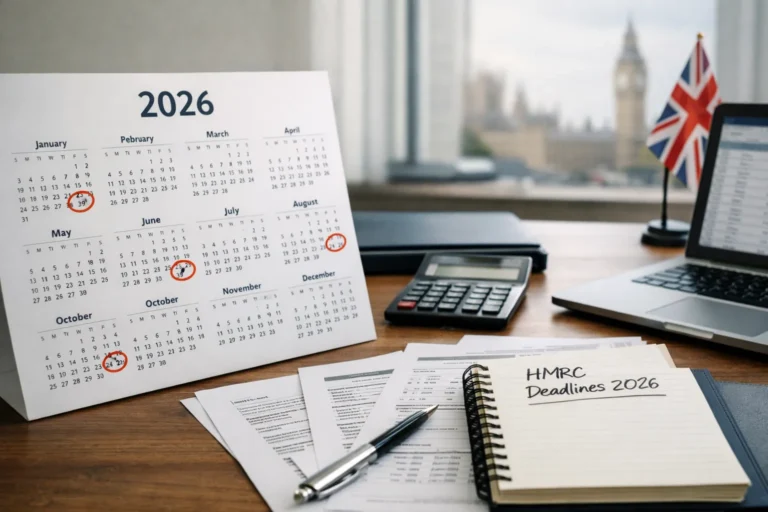
Understanding the Tax Dates 2026 UK is essential for sole traders, landlords, limited companies and employers. Missing a deadline set by HM Revenue & Customs (HMRC) can trigger automatic penalties, interest charges and avoidable stress.
Updated and accurate for 2026.
Introduction
Whether you submit a Self Assessment tax return, run payroll, operate VAT, or manage a limited company, knowing exactly when tax is due protects your cash flow and your compliance record.
This guide is fully updated for 2026 and sets out every major HMRC deadline in a clear, structured format. It covers filing dates, payment deadlines, penalty rules and what happens if you miss them. Use it as your reference calendar for the 2026 tax year.
Self Assessment Tax Dates 2026 UK
Who Must File?
You must submit a Self Assessment tax return if you:
- Are self-employed as a sole trader
- Are a partner in a partnership
- Receive rental income
- Earn over £100,000 annually
- Have significant untaxed income
- Receive dividends above the allowance
Key Self Assessment Deadlines
For the 2025/26 tax year:
- 5 October 2026 – Register for Self Assessment
- 31 October 2026 – Paper return deadline
- 31 January 2027 – Online return deadline
- 31 January 2026 – Balancing payment for 2024/25
- 31 July 2026 – Second payment on account
These dates form the core of the Tax Dates 2026 UK for sole traders and landlords.
Understanding Payments on Account
If your tax bill exceeds £1,000, HMRC usually requires advance payments towards the next tax year.
You will pay:
- 50% on 31 January
- 50% on 31 July
These are based on your previous year’s tax bill.
Late Filing Penalties
Missing the filing deadline results in:
- £100 automatic penalty (even if no tax owed)
- £10 per day after 3 months (up to £900)
- 6 months late: additional 5% of tax due or £300
- 12 months late: further 5% or £300
Late Payment Penalties
If tax remains unpaid:
- 30 days late: 5% penalty
- 6 months late: additional 5%
- 12 months late: additional 5%
Interest Charges
HMRC applies daily interest on overdue amounts. Interest accrues from the day after the due date until full payment is made.
- UK Bank Holidays 2026
- Can Employers Force You to Work on UK Bank Holidays
- How UK Bank Holidays Affect Salaries in 2026
VAT Tax Dates 2026 UK
VAT deadlines operate on a rolling quarterly system.
Quarterly VAT Deadlines
Most VAT-registered businesses submit returns every three months.
The deadline is:
1 month + 7 days after the end of your VAT quarter
For example:
- Quarter ends 31 March
- Deadline: 7 May
This rule applies consistently across the 2026 calendar.
Annual Accounting Scheme
Under this scheme:
- One VAT return per year
- Advance instalments paid during the year
- Balancing payment due 2 months after the year-end
Making Tax Digital (MTD)
VAT-registered businesses must:
- Keep digital records
- Submit returns via MTD-compatible software
Paper returns are no longer permitted for most VAT businesses.
Payment Timing
VAT payments must clear HMRC’s account by the deadline. Late bank transfers can result in penalties.
VAT Penalties
HMRC operates a points-based system:
- Each late submission earns a penalty point
- Reaching the threshold triggers a £200 fine
- Further late submissions incur additional £200 penalties
Late payments also attract interest and potential penalties.
Corporation Tax Deadlines 2026
Corporation Tax applies to UK limited companies.
Who It Applies To
- Limited companies
- Foreign companies with UK branches
- Clubs and associations
Payment Deadline: 9 Months + 1 Day
Corporation Tax must be paid:
9 months and 1 day after the end of your accounting period
Example:
- Accounting year ends 31 December 2025
- Tax due: 1 October 2026
This rule is central to Tax Dates 2026 UK for limited companies.
Filing Deadline: 12 Months
Your Company Tax Return (CT600) must be filed:
12 months after the end of your accounting period
Late Filing Penalties
- 1 day late: £100
- 3 months late: additional £100
- 6 months late: HMRC estimates your bill
- 12 months late: 10% penalty on unpaid tax
Repeated late filing increases penalties significantly.
PAYE & Payroll Tax Dates 2026 UK
If you employ staff, payroll compliance is critical.
Monthly PAYE Deadlines
For electronic payments:
- 22nd of each month
For postal payments:
- 19th of each month
These apply to Income Tax and National Insurance deductions.
Real Time Information (RTI)
Employers must submit payroll information on or before each payday through RTI.
P60 Deadline
Employees must receive their P60 by:
31 May 2026
This summarises pay and deductions for the tax year ending 5 April 2026.
P11D Deadline
If employees receive benefits in kind:
- Submit P11D by 6 July 2026
- Pay Class 1A National Insurance by 22 July (if electronic)
End-of-Year Payroll Requirements
At the end of the tax year:
- Final Full Payment Submission (FPS) by 5 April
- Submit Employer Payment Summary (if required)
What Happens If You Miss a Tax Deadline?
Failing to meet the Tax Dates 2026 UK can trigger escalating consequences.
Automatic £100 Penalty
Self Assessment returns are subject to an immediate £100 fine after the deadline.
Escalating Penalties
Penalties increase over time, including:
- Daily fines
- Percentage-based penalties
- Estimated tax assessments
Interest Charges
Interest applies daily until payment is made.
Enforcement Action
Persistent non-compliance may result in:
- Debt collection
- Enforcement officers
- Court action
Appeals
You may appeal penalties if you have a reasonable excuse, such as:
- Serious illness
- Bereavement
- System failure beyond your control
Appeals must be submitted promptly with supporting evidence.
Downloadable 2026 Tax Calendar
To stay compliant:
- Save key Tax Dates 2026 UK in your calendar
- Set reminders at least two weeks in advance
- Maintain digital records throughout the year
- Review cash flow ahead of payment deadlines
- Speak to a qualified accountant if unsure
Proactive planning prevents penalties and protects working capital.
Download the 2026 UK Tax Calendar (PDF)
Frequently Asked Questions
When is the Self Assessment deadline in 2026?
The online filing deadline for the 2025/26 tax year is 31 January 2027. Payment deadlines occur on 31 January 2026 and 31 July 2026 for payments on account.
What happens if I miss the 31 January deadline?
You receive an automatic £100 penalty. Additional penalties and daily fines apply if the delay continues.
When is Corporation Tax due?
Corporation Tax is payable 9 months and 1 day after your accounting period ends. The return must be filed within 12 months.
Are VAT deadlines the same for all businesses?
No. VAT operates on a rolling quarterly schedule. The deadline is always 1 month + 7 days after your VAT quarter ends, but quarter end dates differ between businesses.
Can I pay tax in installments?
Yes. HMRC may agree to a Time to Pay arrangement if you contact them before the deadline and demonstrate genuine financial difficulty.
Final Thoughts
Managing the Tax Dates 2026 UK is a core responsibility for any UK business owner, landlord or employer. HMRC penalties are automatic, interest accrues daily, and repeated non-compliance can damage your financial position.
Plan ahead. Monitor deadlines carefully. Maintain accurate records. Seek professional advice where needed.
Staying organised ensures compliance, protects your reputation and keeps your business financially stable throughout 2026.