
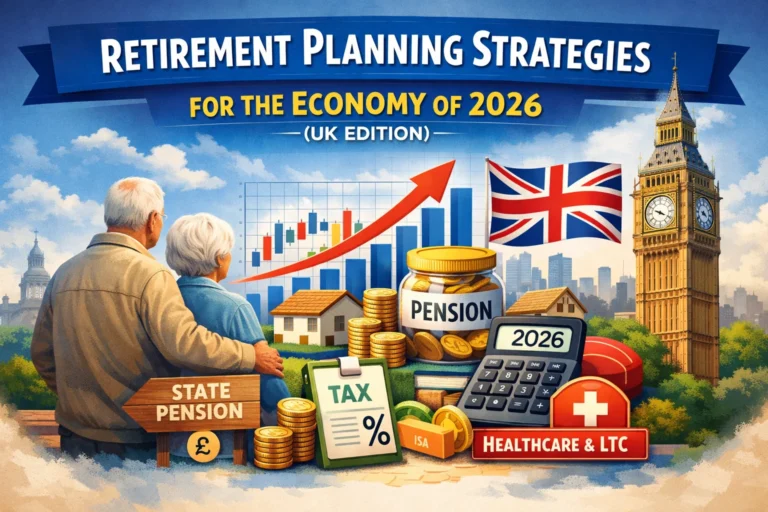
Retirement planning in 2026 has become increasingly complex for UK savers. With shifting economic conditions, frozen tax thresholds, evolving pension rules, and longer lifespans, navigating retirement requires up-to-date strategies grounded in facts and policies. A well-constructed retirement plan not only maximises income and tax efficiency but also addresses healthcare, inflation risk, and longevity. This article provides a comprehensive guide to Retirement Planning Strategies for the Economy of 2026, focusing on the UK context with practical, evidence-based advice.
Planning your year works best when you align your goals with key dates.
To help you do that, you may also want to check:
Retirement Planning in 2026
As the UK enters 2026, macroeconomic indicators show modest inflation and pressures on public finances. The state pension continues to form the backbone of retirement income for many, but it often falls short of covering all living costs. Private pensions, workplace schemes, and personal savings are therefore critical.
- The UK State Pension currently provides a basic foundational income for retirees, but private plans remain essential for a comfortable retirement.
- Demographic shifts show an ageing population and longer life expectancy retirees may need income for 20+ years post-retirement.
- Economic uncertainties like inflation, interest rate changes, and fiscal policy shifts directly impact savings value and retirement income.
Understanding these broader trends helps frame choices around contributions, investment risk, and withdrawal planning. Effective retirement planning combines personal financial goals with macroeconomic realities to build resilient income streams.
Macroeconomic Factors to Consider
Inflation and Cost of Living
Inflation affects purchasing power even a modest rate above target erodes real income over time. Although UK inflation has eased compared with previous years, it remains a concern for fixed-income retirees. Planning must factor in long-term inflation risk, especially for healthcare and housing costs.
Interest Rates and Savings Returns
Bank of England base rates influence returns on savings and bonds. Higher rates can benefit cash savings but may pressure equity markets, which many pensions hold. Understanding interest rate environments helps in balancing growth versus income generation.
Labour Market and Retirement Age
With people working longer and retirement ages increasing, flexibility in drawdown and phased retirement becomes more relevant. Many choose partial retirement or reduce hours before full retirement.
Fiscal Policy and Tax Free Allowances
Tax thresholds on income and savings have been frozen for extended periods, a phenomenon called “fiscal drag.” This increases the likelihood retirees entering higher tax bands over time even without real income increases.
(See Autumn Budget 2025 tax discussions on income and savings taxation).
Pension Reforms and Regulation
In the UK, workplace pensions are subject to evolving regulations. For example, the Financial Conduct Authority plans a four-point rating system for workplace pension performance starting in 2028 to improve transparency and outcomes for savers.
Core Retirement Strategies
Effective retirement planning centres on diversification, tax efficiency, and risk management.
Diversify Retirement Accounts
A mix of pension schemes and tax-advantaged savings vehicles helps reduce risk and improves flexibility:
- Workplace pensions provide employer contributions and tax relief.
- Self-Invested Personal Pensions (SIPPs) give investment control.
- Individual Savings Accounts (ISAs) offer tax-free growth and flexible access.
A diversified approach allows retirees to manage cash flow, tax exposure, and investment risk more effectively.
Tax-Advantaged Contributions
Understanding UK pension allowances is crucial:
- The Annual Allowance for pension contributions stands at £60,000, with tapering for high earners.
- The Money Purchase Annual Allowance (MPAA) reduces to £10,000 once you begin taking flexible income from a pension.
- Lifetime Allowance has been abolished, removing a cap on tax-relieved pension savings but replacing it with limits on tax-free lump sums.
Careful planning ensures you maximise contributions without triggering unnecessary tax charges.
Risk Management and Asset Allocation
Determine asset allocation based on risk tolerance, time to retirement, and income needs. Younger savers might prioritise equity growth, while those near or in retirement often shift toward lower-volatility income-producing assets.
Specific Tools & Vehicles for 2026
Workplace Pensions
Automatic enrollment means most UK workers now build pension savings through employer schemes. Contributions benefit from tax relief and employer matches, making them foundational for long-term planning.
Self-Invested Personal Pensions (SIPPs)
SIPPs offer flexible investment choices and can serve as a central retirement account for experienced investors. Contributions up to the Annual Allowance attract tax relief, while investment gains grow tax-free inside the pension.
Individual Savings Accounts (ISAs)
ISAs provide tax-free growth and withdrawals without penalties. While not as tax-advantaged for contributions, their flexibility is valuable for bridging income before age 57 (when pension access increases). ISA allowances in 2026 remain £20,000 per year.
Lifetime ISAs (LISAs)
LISAs can provide a 25% government bonus but have limited use cases (first home purchase or retirement). Proposed reform may simplify products by 2026.
Annuities and Drawdown
Annuities offer guaranteed income for life, while drawdown allows investment growth with flexible withdrawals. Balancing these helps manage longevity risk and inflation.
Planning for Longevity, Healthcare, and Long-Term Care
Healthcare Costs
While the NHS covers many services, retirees still face significant out-of-pocket expenses for dental, optical, and long-term care not covered by state services. Building reserves or holding funds within ISAs to meet such costs is prudent.
Long-Term Care Considerations
Long-term care insurance can help mitigate the high costs of extended care. Evaluate products based on age, health status, and family history.
Medicare-Equivalent Coverage
Unlike the US system, the UK’s NHS offers broad healthcare coverage. However, supplemental private healthcare can reduce waiting times and provide additional peace of mind for those with chronic or complex needs.
Drawdown Strategies After Retirement
Once you reach pension access age (currently 55, rising to 57 in 2028), planning how to withdraw income is essential.
Sequential Withdrawal Planning
Consider pulling income first from sources with the least tax efficiency or that might push you into higher tax brackets. For example:
- Use ISA savings before pension drawdowns if income tax is a concern.
- Take tax-free lump sums up to permitted limits.
- Plan pension drawdowns to stay within tax bands through the personal allowance threshold and basic rates.
Tax-Efficient Drawdowns
UK rules allow up to 25% of a pension fund as a tax-free lump sum (capped by a Lump Sum Allowance of £268,275). Withdrawals beyond this are taxable as income.
Required Minimum Distributions
Unlike US pensions with RMDs, the UK does not mandate minimum withdrawals from private pensions at any specific age, offering more flexibility in timing and tax planning.
Case Studies: Retirement Plans for Different UK Savers
Case Study 1: Mid-Career Professional (Age 45)
Profile: Age 45, salary £60,000, workplace pension with 5% employee and 3% employer contributions, ISA savings of £30,000.
Plan:
- Increase pension contributions to maximise employer match.
- Use carry-forward rules to add unused allowances.
- Allocate ISA funds to growth-oriented investments with rebalancing.
- Target £750,000+ pension pot by age 67 through diversified strategies.
Outcome: Balances tax relief, employer contributions, and flexibility to bridge income gaps before pension access age.
Case Study 2: Pre-Retiree (Age 58)
Profile: Age 58, combined pension pots £350,000, ISA savings £100,000, no dependents, plans to retire at 60.
Plan:
- Draw from ISA funds for early retirement income.
- Take 25% tax-free pension lump sum up to existing Lump Sum Allowance.
- Consider part-annuity for guaranteed base income.
- Use drawdown for flexible income above base.
Outcome: Tax-efficient income, lowers reliance on taxable pension drawdowns, and preserves future tax-free ISA withdrawals.
Actionable Checklists
UK Retirement Planning Checklist (2026)
Contributions & Accounts
- Confirm workplace pension contribution and employer match.
- Annual Allowance and utilise carry-forward.
- Contribute to ISAs (up to £20,000).
- Review SIPPs for individual investment flexibility.
Tax Planning
- Calculate potential MPAA triggers.
- Review pension tax-free cash caps (LSA).
Withdrawal Strategy
- Plan sequential withdrawals using ISA before taxable pension.
- Determine annuity vs drawdown balance.
Healthcare & Longevity
- Assess private healthcare or long-term care needs.
- Estimate future healthcare costs.
Monitoring
- Rebalance portfolios annually.
- Review pension and ISA allowances yearly.
Frequently Asked Questions (FAQ)
What is the key retirement planning change in 2026 UK?
The abolition of the Lifetime Allowance removed a cap on pension tax relief, but limits remain on tax-free lump sums.
How much can I withdraw tax-free from my pension?
Up to 25% of your pension fund tax-free, subject to the Lump Sum Allowance of £268,275.
Should I prioritise ISAs or pensions?
Use pensions for tax relief and employer match; use ISAs for flexibility and tax-free income before pension access age.
When can I access my pension in the UK?
Pension access begins at age 55, rising to age 57 in 2028.
How can I minimise tax in retirement?
Sequence withdrawals, use tax-free ISAs first, and stay within personal allowance bands.
Conclusion and Next Steps
Planning for retirement in 2026 demands a nuanced approach that blends UK policy awareness with sound financial strategies. Incorporating diversified savings, tax planning, and income sequencing sets the stage for a resilient retirement plan. Use this guide to review your current plan, make informed adjustments, and seek professional financial advice tailored to your circumstances.
With careful planning and disciplined saving, you can navigate the evolving economic landscape of 2026 and build a secure, sustainable retirement income stream.