
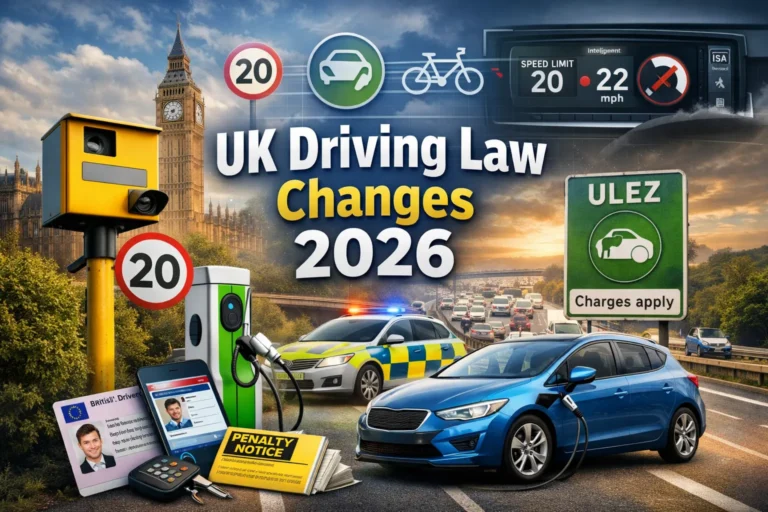
The landscape of motoring law in the United Kingdom is evolving rapidly. In 2026, motorists will be driving under a legal framework shaped by road safety reform, environmental targets, digital enforcement technology, and changes in how vehicles themselves are regulated. These updates are not sudden or speculative: most stem from legislation, consultations, and policy commitments made between 2020 and 2024, many of which are scheduled to take effect or reach full operational enforcement in 2026.
For everyday drivers, these changes matter. They affect how licences are managed, how vehicles are taxed and insured, how offences are enforced, where you can drive, and what standards your car must meet. Some changes impose new legal duties; others expand existing schemes such as clean air zones, automated enforcement, and vehicle technology requirements.
This article provides a comprehensive, factual, and practical guide to UK driving law changes for motorists in 2026, based on UK government legislation, Department for Transport policy papers, parliamentary committee reports, and reputable sources including the BBC, RAC, and AA. It focuses on what is confirmed, how it affects drivers, and what you should do to stay compliant.
Summary of key legislative updates affecting motorists in 2026
Expansion and consolidation of Clean Air Zones and ULEZ-style schemes
Status: Ongoing implementation
Legal basis: Environment Act 2021; local authority powers under the Transport Act 2000
Key date: 2024–2026 phased enforcement
In 2026, more UK cities will have fully enforced Clean Air Zones (CAZ) or Ultra Low Emission Zone–style charging schemes. While London’s ULEZ expansion completed in 2023, cities such as Birmingham, Sheffield, Bradford, Bristol, and Newcastle are continuing phased tightening of emissions standards and enforcement regimes.
Local authorities are legally empowered to:
- Charge non-compliant vehicles daily
- Use ANPR camera enforcement
- Increase penalty charges for repeated non-compliance
The Department for Transport (DfT) has confirmed that CAZ enforcement data-sharing and compliance systems will be standardised nationally by mid-decade.
Official sources:
- Department for Transport, Clean Air Zone Framework
- Gov.uk, Clean Air Zones guidance for drivers
Public transport in the United Kingdom is on the cusp of a major transformation… Continue reading>>
Zero Emission Vehicle (ZEV) mandate compliance milestones
Status: Legally enacted
Legal basis: ZEV Mandate Regulations 2023
Key date: 2026 compliance year
The Zero Emission Vehicle mandate, introduced in 2024, requires manufacturers to ensure a minimum percentage of new car sales are zero-emission. In 2026, the required share rises significantly compared to launch years.
While the mandate applies to manufacturers rather than private drivers, it has direct effects on motorists, including:
- Reduced availability of new petrol/diesel models
- Increased EV incentives and price competition
- Insurance and servicing changes linked to EV adoption
Used car markets will also be affected, particularly for Euro 5 diesel vehicles increasingly excluded from urban zones.
Official sources:
- Gov.uk, Zero Emission Vehicle mandate explained
- House of Commons Library briefing, Electric vehicles and the UK car market
Digital driving licence and DVLA enforcement modernisation
Status: Pilot programmes and secondary legislation
Legal basis: DVLA modernisation programme
Key date: 2025–2026 rollout
In 2026, the DVLA’s digital driving licence system is expected to be operational nationwide. Physical photocard licences remain valid, but motorists will increasingly interact with:
- Digital licence verification for hire vehicles and insurers
- Real-time penalty point updates
- Automated reminders for medical declarations and renewals
Failure to keep digital records accurate may result in fines or licence suspension, especially for professional and older drivers with medical reporting obligations.
Official sources:
- DVLA policy updates, Gov.uk
- BBC News, Digital driving licences explained
The United Kingdom is undergoing a major shift in how it regulates technology, data, and digital services… Continue reading>>
Highway Code enforcement and vulnerable road user protections
Status: In force; enforcement strengthening
Legal basis: Highway Code updates (2022); Road Safety Framework
Key date: 2026 enforcement guidance
Rules prioritising pedestrians, cyclists, and horse riders are already law, but in 2026 police forces and local authorities are expected to actively enforce:
- Close-passing offences
- Junction priority violations
- Failure to yield at crossings
This follows recommendations from the House of Commons Transport Committee, which criticised inconsistent enforcement in earlier years.
Official sources:
- Gov.uk, The Highway Code
- House of Commons Transport Committee, Road safety report
Speed limit technology and “intelligent speed assistance” (ISA)
Status: International standard adoption
Legal basis: UNECE vehicle regulations; UK vehicle type approval
Key date: Applies to new vehicles registered in 2026
New cars approved for sale in the UK in 2026 increasingly include Intelligent Speed Assistance (ISA) systems. While drivers can override them, these systems:
- Warn when exceeding limits
- Record speed data in some models
- Integrate with insurance telematics
ISA is not mandatory to use, but tampering or disabling systems may affect insurance validity.
Official sources:
- RAC Foundation, Speed assistance technology
- Department for Transport vehicle standards guidance
Harsher penalties for mobile phone use and distracted driving
Status: Sentencing guidance updates
Legal basis: Road Traffic Act 1988; Sentencing Council guidelines
Key date: Updated guidance effective in 2026
Courts now have expanded discretion to impose:
- Higher fines
- Longer disqualification periods
- Mandatory retesting
This applies not only to handheld phone use but also to touchscreen interaction while driving, including sat-nav input when moving.
Official sources:
- Sentencing Council for England and Wales
- Gov.uk, Using a mobile phone while driving
Biggest UK tours and concerts in 2026, concert schedule 2026 UK, 2026 UK festivals, and major UK concerts… Continue reading>>
Impact on motorists: what changes in practice?
Licensing and driver records
Drivers will need to:
- Monitor digital licence records
- Ensure medical conditions are reported promptly
- Respond quickly to electronic notices
Failure to engage digitally will not be a defence.
Insurance implications
Insurers are increasingly using:
- Vehicle data (ISA, ADAS systems)
- CAZ compliance records
- Digital licence checks
Non-compliance can lead to higher premiums or invalidated cover.
Vehicle standards and emissions
In 2026:
- Euro 6 compliance is effectively the minimum in many cities
- Diesel ownership remains legal but less practical
- EV servicing and battery health reporting becomes standard
Case examples: how different drivers are affected
Commuter driver (urban)
A petrol car registered in 2015 may incur daily CAZ charges, making replacement or modal shift financially sensible.
New driver
Telematics insurance increasingly integrates with ISA and digital licence checks, meaning speed and distraction offences carry faster consequences.
Business driver
Fleet compliance systems must track CAZ charges, licence status, and vehicle standards to avoid corporate liability.
Older driver
Medical reporting deadlines are enforced digitally; missed declarations risk automatic licence revocation.
Practical tips: how to prepare in 2026
- Check your vehicle’s emissions rating now
- Register for DVLA digital services
- Review insurance terms for tech clauses
- Familiarise yourself with local CAZ rules
- Keep Highway Code knowledge up to date
FAQs
Will petrol and diesel cars be banned in 2026?
No. The ban on new petrol and diesel cars applies from 2035. However, restrictions on where you can drive them continue to expand.
Do I have to use a digital driving licence?
Physical licences remain valid, but digital systems will increasingly be the default.
Are speed limiters compulsory?
No, but speed assistance systems are standard in new cars.
The UK tech sector is entering one of the most transformative periods in its history. UK Tech Jobs in 2026
Conclusion: stay informed, stay compliant
The UK driving law changes for motorists in 2026 reflect long-term policy goals rather than sudden rulemaking. For drivers, the key is awareness and preparation. Laws are being enforced more consistently, digitally, and automatically. Checking official guidance regularly and adapting early will save money, time, and stress.
Official sources and references (accessed 2024–2025)
- Gov.uk – Department for Transport
- DVLA Digital Services
- House of Commons Transport Committee – Road safety
- RAC Foundation – Motoring law and technology
- AA – Driving advice and legal updates
- BBC News – UK transport policy reporting
Last updated: January 2026