
Signing a lease is one of the most financially consequential things most people do and most people spend less than 20 minutes on it.
Read this. Things Every Renter Must Do Before Signing a Lease including how to use AI to check your lease against state law.
Your landlord spent money on a lawyer to write that document. It was written to protect them, not you. Before you put your name on anything, here are seven things every renter should do in 2026.
Read the entire lease — yes, all of it
Things Every Renter Must Do Before Signing a Lease
This sounds obvious. Almost nobody does it.
The average residential lease is 15 to 30 pages. Most renters skim the rent amount, the move-in date, and sign. The dangerous clauses the ones that cost money are buried in the middle pages.
Read every paragraph. If you do not understand something, flag it before signing. A landlord who pressures you to sign quickly without reading is a red flag in itself.
Know your state’s security deposit laws
Security deposit rules vary dramatically by state. In New York, your landlord must return your deposit within 14 days. In Arkansas, they have 60 days. In California, they cannot charge more than two months’ rent as a deposit.
If your lease contains a deposit clause that contradicts your state’s law, that clause may be unenforceable but you need to know that before you sign, not after you’ve already paid.
Look up your state’s specific deposit rules before you hand over any money.
Document everything at move-in with photos and video
The single most common landlord-tenant dispute is over security deposit deductions at move-out. Landlords claim damage. Tenants say it was pre-existing. Without documentation, the tenant almost always loses.
On your move-in day, before you bring a single box inside, walk through every room and record a detailed video. Open every cabinet, photograph every scuff, every stain, every crack. Date-stamp everything.
Send a copy to your landlord by email so there is a timestamped record they received it. This one step protects your entire deposit.
If you’re planning a city break this year and need to sort accommodation once you land, our guide to the best hotels for UK city breaks by budget tier covers London, Edinburgh, Manchester, and Bath in detail.
Understand the late fee structure
Late fee clauses are where landlords get creative. A flat $25 fee is standard. What is not standard but increasingly common is a stacking fee that adds a daily charge on top of the flat fee.
A lease that charges $25 plus $5 per day means that if you are 10 days late, you owe an extra $70. Miss rent by a full month and that number becomes $175 in fees alone.
Check whether your state caps late fees. Several states do. If your lease’s late fee exceeds the legal cap, it may not be enforceable but again, you need to know this before you sign.
Check the landlord entry clause
Most states require landlords to give 24 to 48 hours notice before entering your unit. Some states require no notice at all.
Check what your lease says and compare it to your state’s law. If your lease says the landlord can enter “at any time” or “with reasonable notice” without defining what reasonable means, that is worth flagging before you sign.
Your home is your home. You have a right to know who can enter it and when.
Understand the renewal terms
Automatic lease renewal clauses are among the most expensive surprises in renting. A standard clause requires you to give 60 days written notice before your lease ends if you do not want to renew otherwise the lease automatically extends for another full year.
Miss that window by one day and you are legally bound to another 12 months of rent.
Read your renewal clause carefully. Note the exact deadline. Set a calendar reminder 90 days before your lease ends so you never miss it.
Run your lease through an AI analyzer before signing
This is the step that did not exist a few years ago.
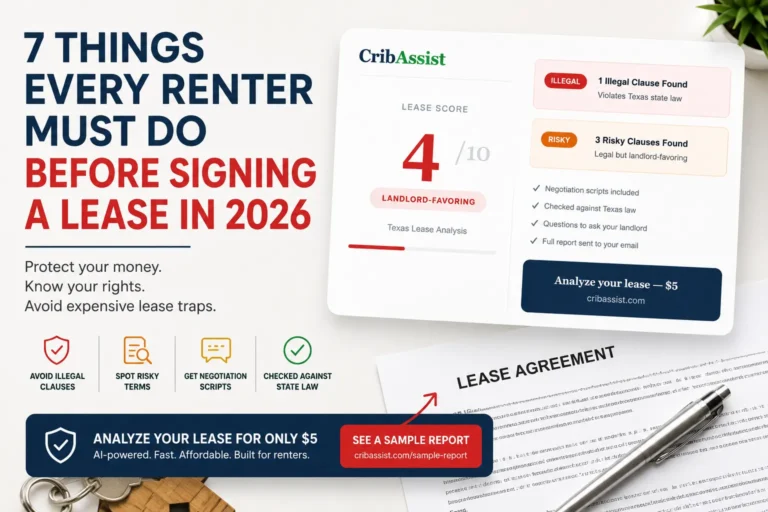
Tools like Crib Assist now let renters upload their lease PDF, select their state, and get a complete risk analysis in under 60 seconds. The tool checks every clause against your state’s actual landlord-tenant laws, flags anything illegal or risky, and gives you copy-ready scripts to negotiate with your landlord before signing.
It costs $5 — one-time, no subscription. For context, a lawyer charges $300 an hour to do what this tool does in a minute.
You can see exactly what a full analysis looks like at cribassist.com/sample-report before paying anything.
In 2026, there is no excuse for signing a lease blind. The information asymmetry between landlords and tenants has existed for decades. AI tools are finally closing that gap.
The Bottom Line
Your landlord’s lease was written by a professional to protect your landlord. Reading it carefully, knowing your state’s laws, and using the tools available to you in 2026 is the difference between a smooth tenancy and an expensive dispute.
Take the 60 minutes. Read the lease. Know your rights. And before you sign run it through Crib Assist.