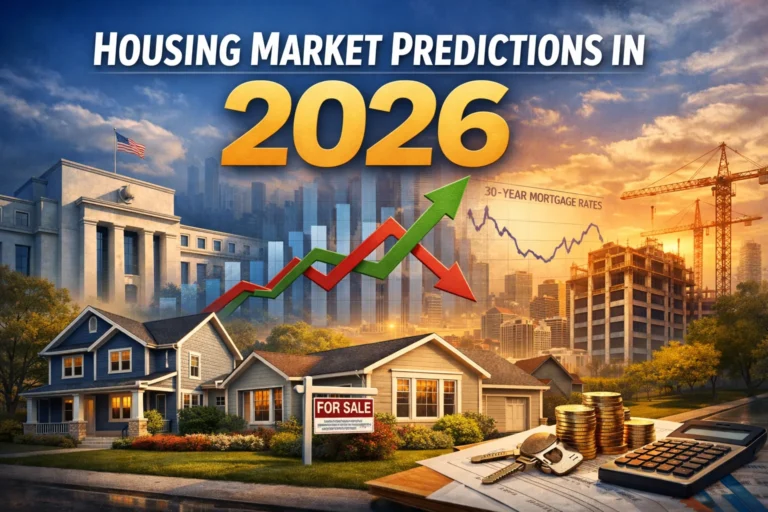
The housing market predictions in 2026 are being shaped by a unique mix of post-pandemic normalization, restrictive monetary policy hangovers, demographic pressure, and persistent supply constraints. After several years of volatility marked by rapid price appreciation in 2020–2022, a sharp interest-rate shock in 2023, and cautious stabilization through 2024–2025 the U.S. housing market is entering 2026 at an inflection point.
Unlike the boom-bust cycles of the past, today’s real estate outlook reflects structural changes: chronic underbuilding, elevated homeowner equity, stricter lending standards, and shifting household formation patterns. As a result, most real estate forecasts for 2026 do not anticipate a dramatic nationwide crash or a renewed speculative surge. Instead, experts expect a market characterized by uneven regional performance, modest price movements, and continued affordability challenges.
This article provides a data-driven, non-speculative analysis of housing market trends in 2026, drawing on forecasts and research from the Federal Reserve, U.S. Census Bureau, National Association of Realtors, Realtor.com, Bloomberg, and The Wall Street Journal. Where predictions are made, they are tied directly to economic indicators, historical patterns, and expert consensus not conjecture.
Current State of the Housing Market
By the end of 2025, the U.S. housing market is best described as constrained but resilient.
Home Prices
According to data aggregated by the Federal Housing Finance Agency (FHFA) and private indices such as Case-Shiller, national home prices remain near record highs in nominal terms. After double-digit annual growth during the pandemic years, appreciation cooled significantly:
- 2023–2024: Price growth slowed to low single digits
- 2025: Many markets saw flat to modestly positive appreciation (0–4% year over year)
Importantly, price declines were limited and localized, largely because distressed sales remained historically low.
Sales Activity
Existing home sales in 2025 are still well below pre-pandemic norms. The primary culprit is the so-called “rate lock-in effect.” Millions of homeowners refinanced into 2.5–3.5% mortgages between 2020 and 2022 and are reluctant to sell and take on new loans at rates near 6–7%.
The National Association of Realtors reported that existing home sales volumes in 2025 hovered roughly 25–30% below the long-term average, despite strong underlying demand.
Mortgage Rates
Mortgage rates remain elevated relative to the past decade but are no longer rising aggressively. The average 30-year fixed rate in 2025 generally fluctuated between 6% and 7%, reflecting tighter financial conditions set by the Federal Reserve.
This sets the baseline from which housing market predictions in 2026 must be evaluated.
Key Economic Indicators Affecting Housing in 2026
Housing does not operate in isolation. Several macroeconomic indicators will play an outsized role in determining home prices in 2026 and overall market health.
Monetary Policy and Inflation
The Federal Reserve’s dual mandate price stability and maximum employment remains central to housing outcomes.
- By late 2025, inflation has moderated significantly from its 2022 peak.
- Core inflation remains above the Fed’s 2% target but is trending lower.
- Futures markets and economist surveys cited by Bloomberg suggest gradual policy easing, not aggressive rate cuts.
For housing, this implies:
- Mortgage rates may decline modestly in 2026
- A return to ultra-low rates (<4%) is unlikely without a major recession
Employment and Wage Growth
The U.S. labor market entering 2026 is expected to cool slightly but remain relatively strong. The Bureau of Labor Statistics shows wage growth outpacing inflation in many sectors, which partially offsets affordability pressures.
Stable employment reduces the risk of widespread foreclosures, supporting price stability.
Demographics and Household Formation
Demographic demand remains a powerful tailwind:
- Millennials, the largest generation in U.S. history, continue to age into peak home-buying years
- Gen Z household formation accelerates through the mid-2020s
- Immigration trends, tracked by the Census Bureau, add incremental housing demand
These factors underpin most real estate forecasts for 2026, even in a slower-growth economy.
Regional Market Differences: A Fragmented Outlook
One of the most important housing market trends in 2026 is regional divergence. National averages obscure meaningful differences across metros and states.
Sun Belt Markets
Markets across Texas, Florida, Arizona, and parts of the Southeast experienced outsized growth from 2020 to 2022. By 2025:
- Population growth remains strong
- Inventory has increased faster than in coastal markets
- Price growth has normalized or turned flat in some metros
Forecasts from Realtor.com suggest modest appreciation or stagnation in 2026 rather than sharp corrections.
Northeast and Midwest
These regions tend to exhibit:
- Slower population growth
- Lower new construction
- More stable pricing dynamics
In many Midwest metros, relative affordability may support above-average demand growth in 2026, especially if remote and hybrid work remains common.
West Coast
High-cost coastal markets face structural affordability challenges:
- Elevated prices relative to income
- Strict zoning and land-use regulations
- Out-migration to lower-cost states
However, limited supply and strong job centers (tech, biotech, entertainment) may prevent large price declines.
Interest Rates and Affordability in 2026
Affordability remains the defining challenge of the housing market.
Mortgage Rates Outlook
Most major forecasters including analysts cited by The Wall Street Journal expect mortgage rates in 2026 to:
- Drift lower than 2025 averages
- Likely settle in the mid-5% to low-6% range, assuming no inflation resurgence
Even a 1-percentage-point decline meaningfully impacts monthly payments, but affordability would still be well below 2019 levels.
Price-to-Income Ratios
According to Census and FHFA data:
- National price-to-income ratios remain near multi-decade highs
- First-time buyers face the steepest barriers
As a result, housing market predictions in 2026 generally assume:
- Continued pressure on entry-level buyers
- Growing demand for smaller homes, townhouses, and multifamily units
Inventory and Construction Trends
Existing Home Inventory
Inventory remains historically low due to the rate lock-in effect. While listings increased modestly in 2024–2025, they remain far below pre-pandemic norms.
The National Association of Realtors estimates the U.S. housing market remains several million units short of long-term equilibrium.
New Construction
Homebuilders responded aggressively in certain regions, aided by:
- Builder rate buy-downs
- Smaller floor plans
- Higher-density developments
Data from the Census Bureau show housing starts recovering but constrained by labor shortages, zoning limits, and financing costs. In 2026, new construction is expected to:
- Grow slowly
- Focus on multifamily and entry-level segments
- Partially but not fully ease supply shortages
Buyer and Seller Behavior in 2026
Buyers
Buyers entering the 2026 market are more cautious and analytical than during the pandemic boom:
- Greater sensitivity to mortgage rates
- Increased use of adjustable-rate or temporary buy-down products
- Willingness to compromise on location or size
First-time buyers increasingly rely on family assistance, a trend highlighted in multiple NAR surveys.
Sellers
Sellers remain constrained:
- Many are unwilling to give up low-rate mortgages
- Downsizers and relocators drive a disproportionate share of listings
This dynamic supports price stability, even in slower demand environments.
Expert Consensus: Housing Market Predictions in 2026
Across major research institutions and media outlets, a general consensus emerges:
- Home prices 2026: Flat to modest growth nationally (0–4%)
- Sales volume: Gradual recovery, not a surge
- Mortgage rates: Lower than 2025, but structurally higher than the 2010s
- Risk of crash: Low, absent a severe recession
Bloomberg economists emphasize that today’s market lacks the excessive leverage and speculative lending that preceded the 2008 housing crash.
Risks and Uncertainties
No forecast is without risk. Key uncertainties include:
- Inflation resurgence
Would delay or reverse rate cuts. - Labor market deterioration
Rising unemployment could pressure prices regionally. - Policy and regulatory shifts
Zoning reform or housing subsidies could alter supply dynamics. - Geopolitical or financial shocks
External events affecting capital markets and consumer confidence.
These risks underscore why housing market predictions in 2026 should be viewed as probabilistic, not deterministic.
Summary and Key Takeaways
- The U.S. housing market entering 2026 is tight, expensive, and structurally constrained
- Price growth is expected to be modest and uneven, not explosive or catastrophic
- Affordability remains the central challenge for buyers
- Regional differences matter more than national averages
- Supply shortages and demographic demand provide a long-term floor under prices
For investors, builders, policymakers, and homeowners, 2026 is likely to reward patience, data-driven decision-making, and local market knowledge rather than speculative bets.
Sources
- Federal Reserve – Monetary policy statements, housing and financial stability reports
- U.S. Census Bureau – Housing starts, household formation, demographic data
- National Association of Realtors – Existing home sales, affordability indices
- Federal Housing Finance Agency – House Price Index (HPI)
- Bloomberg – U.S. housing market analysis and economist surveys
- The Wall Street Journal – Mortgage rate outlooks and housing trends
- Realtor.com Research – Regional market forecasts and inventory analysis