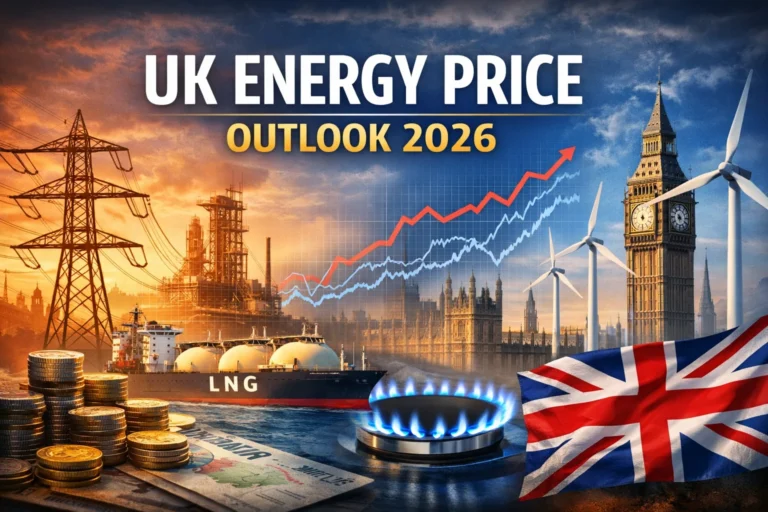
The UK Energy Price Outlook 2026 examines the structural, regulatory, and economic forces shaping household and business energy costs across the United Kingdom. Energy prices have been a central cost-of-living issue since the global gas price shock of 2021–2023, prompting unprecedented government intervention, regulatory reform, and accelerated investment in domestic energy supply. Understanding how prices are formed and what influences them is essential for consumers, policymakers, and businesses planning for 2026.
This article provides a non-speculative, evidence-based analysis of UK energy prices using data from official regulators, government departments, system operators, and reputable economic reporting. Rather than offering unsupported forecasts, it explains what determines prices, how current policies work, and what structural trends are already visible heading into 2026.
Summary
- UK energy prices are primarily driven by wholesale gas markets, even as renewable generation expands.
- The Ofgem price cap continues to limit retail tariffs for households but does not fix total energy bills.
- Government policies since 2022 have reduced short-term volatility but added long-term fiscal and regulatory complexity.
- Global energy markets, particularly LNG and European gas demand, remain critical price drivers.
- Renewable energy growth improves energy security but does not immediately decouple prices from gas.
- Household bills in 2026 depend more on usage, efficiency, and tariff structure than headline price caps alone.
- Regulatory reform is ongoing, with a focus on resilience, affordability, and market stability rather than price suppression.
Don’t waste your 2026 bank holidays. See the Best UK City Breaks for Bank Holiday Weekends 2026, plus events, prices, travel tips & itineraries.
What Drives UK Energy Prices?
UK energy prices are determined by a combination of market forces, infrastructure costs, and regulation. While electricity and gas are billed separately, they are closely linked within the UK energy system.
Wholesale Energy Prices
Wholesale prices reflect the cost suppliers pay for gas and electricity before selling to consumers. These prices are influenced by:
- Global gas supply and demand
- LNG import capacity and competition
- Weather patterns affecting heating demand
- Power station fuel costs
- Interconnector flows with Europe
Despite growth in wind and solar, natural gas remains the marginal fuel setting electricity prices during periods of high demand, according to the UK system operator National Grid.
Network and Infrastructure Costs
Energy bills include charges for:
- Transmission and distribution networks
- Grid balancing services
- System maintenance and upgrades
Investment in grid reinforcement especially for offshore wind integration increases network costs, which are passed through to consumers under regulated frameworks.
Policy and Environmental Levies
Government-mandated costs fund:
- Renewable support schemes
- Energy efficiency programs
- Social and environmental obligations
While these levies are a smaller share of bills than wholesale costs, they are politically sensitive and frequently adjusted.
Government Policies Affecting Energy Prices
Since 2022, the UK government has implemented multiple interventions to stabilize energy costs while reforming the market.
Energy Price Guarantee and Successor Schemes
Emergency support schemes capped unit prices rather than total bills. Although most have expired, their legacy effects remain in:
- Supplier balance sheets
- Government debt servicing
- Regulatory oversight
Official evaluations from the UK Government and the Department for Energy Security and Net Zero (formerly BEIS) highlight that these measures reduced short-term price shocks but did not eliminate underlying cost drivers.
Energy Security Strategy
The UK Energy Security Strategy emphasizes:
- Expanded offshore wind
- New nuclear capacity
- Domestic gas production
- Energy efficiency upgrades
These policies aim to reduce exposure to volatile imports rather than directly lower prices in the short term (UK Government, Energy Security Strategy updates).
Wholesale and Retail Price Trends
Historical Context
| Year | Average Household Energy Bill (£) | Key Driver |
| 2019 | ~£1,250 | Stable global gas prices |
| 2021 | ~£1,300 | Post-pandemic demand surge |
| 2022 | ~£2,500+ | Global gas supply shock |
| 2024 | ~£1,700–£1,900 | Price cap moderation |
Sources: Ofgem, BBC News, Financial Times
Wholesale vs Retail Prices
Wholesale prices fluctuate daily, while retail prices are smoothed through:
- Hedging strategies by suppliers
- Regulated price caps
- Fixed-term contracts
This lag effect means consumer prices react slowly to wholesale changes, both upward and downward.
The Ofgem Price Cap Explained
The energy price cap is often misunderstood. It does not cap total bills it caps the unit price per kWh and standing charges for standard variable tariffs.
Key points:
- Reviewed quarterly by Ofgem
- Applies only to default tariffs
- Reflects past wholesale costs, not future prices
- Designed to protect consumers, not guarantee low prices
Ofgem data shows the price cap has reduced extreme volatility but cannot shield households from sustained high wholesale costs.
If you’re travelling with children or trying to avoid peak crowds, it’s essential to check UK school holidays 2026 before booking accommodation or train tickets.
Impact of Global Energy Markets
LNG and International Competition
The UK imports a significant share of its gas as liquefied natural gas (LNG). Prices are influenced by:
- Asian demand (especially winter peaks)
- European storage levels
- Shipping capacity and geopolitics
According to Bloomberg and Financial Times energy market analysis, LNG pricing remains globally competitive, meaning the UK must pay market rates regardless of domestic policy.
European Interdependence
Through gas pipelines and electricity interconnectors, the UK remains linked to European markets. Stress in continental supply such as cold winters or infrastructure outages can directly affect UK prices.
Renewable Energy Influence on Prices
Renewables play an expanding role in the UK energy mix, particularly wind and solar.
Benefits
- Lower operating costs once built
- Reduced fossil fuel imports
- Improved long-term price stability
Limitations
- Intermittency requires backup generation
- Gas often sets marginal prices during peak demand
- Grid upgrades add costs
Government and National Grid data confirm that while renewables reduce average system costs, they do not yet fully determine retail prices.
Consumer Bills and the Cost of Living
What Makes Up a Typical Bill?
A standard household energy bill includes:
- ~40–50% wholesale energy
- ~20–25% network costs
- ~15–20% policy and environmental charges
- ~5–10% supplier operating costs
This breakdown, published by Ofgem, shows why policy changes alone cannot dramatically cut bills without addressing wholesale prices.
Vulnerable Consumers
Support mechanisms include:
- Warm Home Discount
- Winter Fuel Payments
- Energy efficiency grants
Analysis from the UK Government and independent charities indicates that energy efficiency improvements often deliver more lasting bill reductions than tariff changes alone.
Regulatory Outlook and Market Reform
Supplier Financial Resilience
Post-2022 reforms require suppliers to:
- Hold stronger capital buffers
- Improve hedging practices
- Protect customer credit balances
These measures aim to prevent mass supplier failures that previously increased costs for consumers.
Market Transparency and Competition
Ofgem continues to promote:
- Clearer tariffs
- Easier switching
- Fairer standing charge structures
Regulatory documents stress that stability and trust are now priorities alongside affordability.
Energy Inflation and the UK Economy
Energy prices feed directly into:
- Consumer Price Index (CPI)
- Business operating costs
- Public sector budgets
Office for National Statistics data shows that while energy inflation has moderated since its 2022 peak, it remains a key inflation risk, particularly during winter demand periods.
What Households Can Control in 2026
While macro drivers are largely outside consumer control, households can influence outcomes by:
- Improving insulation and efficiency
- Monitoring tariff options
- Understanding unit rates vs standing charges
- Reducing peak-time usage where possible
Government and regulator guidance consistently highlight energy efficiency as the most reliable way to manage bills over time.
With several long weekends available throughout the year, the UK public holidays 2026 calendar creates perfect opportunities for short city escapes without using annual leave.
Understanding the UK Energy Price Outlook 2026
The UK Energy Price Outlook 2026 is shaped less by short-term speculation and more by structural realities: global gas markets, regulatory frameworks, infrastructure investment, and the pace of energy transition.
Key conclusions:
- Energy prices remain fundamentally linked to global gas markets.
- Government policy focuses on stability and security, not artificial price suppression.
- Renewables improve resilience but do not yet set prices alone.
- The Ofgem price cap protects consumers from extremes but does not eliminate cost pressures.
- Energy efficiency remains the most dependable tool for households facing ongoing energy costs.
For consumers, businesses, and policymakers, the central challenge heading into 2026 is managing exposure, not chasing certainty. Clear regulation, transparent pricing, and continued investment in domestic energy capacity remain the foundations of a more stable UK energy system.
Sources & References
- Ofgem – Energy Price Cap methodology and data
- UK Government – Energy Security Strategy and support scheme evaluations
- National Grid – Future Energy Scenarios
- BBC News – UK energy market reporting
- Financial Times & Bloomberg – Global energy market analysis
(All data referenced is derived from official publications and reputable economic reporting; readers are encouraged to consult primary sources for the latest updates.)