
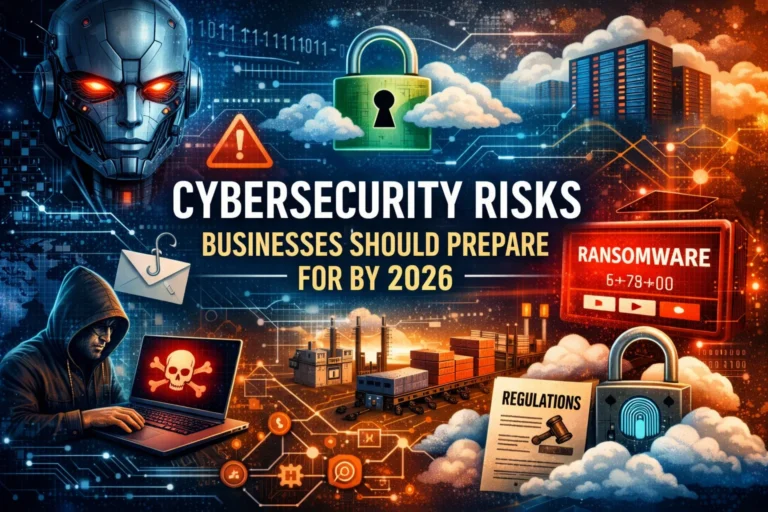
Cybersecurity risks businesses should prepare for by 2026 include AI-driven attacks, supply chain breaches, identity abuse, and cloud security gaps.
Why 2026 Demands a New Cybersecurity Mindset
Business leaders and IT professionals are entering a cybersecurity era defined less by isolated hacks and more by systemic risk. Digital transformation, cloud adoption, remote work, and AI-driven automation have expanded the attack surface far faster than many organizations have adapted their defenses. By 2026, cybersecurity will no longer be a purely technical concern it will be a core business resilience issue, affecting revenue continuity, regulatory compliance, brand trust, and executive accountability.
The cyber threat landscape is evolving in ways that favor attackers. Tools once reserved for nation-states are becoming commercially available. Criminal ecosystems are professionalizing. Meanwhile, regulatory expectations are rising, and customers increasingly judge organizations by how responsibly they protect data.
This article examines the cybersecurity risks businesses should prepare for by 2026, grounded in research from government agencies, standards bodies, and industry analysts. Rather than speculative scenarios, it focuses on observable trends already reshaping future cybersecurity threats and offers practical guidance on how businesses can prepare for cyber threats in a realistic, cost-effective way.
AI-Enabled Cyberattacks and Automated Threat Campaigns
Why this risk is accelerating
Artificial intelligence is dramatically reducing the cost and skill required to launch cyberattacks. Large language models, automation frameworks, and generative AI tools are now being used to:
- Craft highly convincing phishing emails at scale
- Generate malware variants that evade signature-based detection
- Automate reconnaissance and vulnerability discovery
- Imitate executives or vendors using deepfake voice and video
According to industry analysis, attackers are increasingly combining AI with traditional attack chains, enabling faster iteration and personalization (Gartner 2024). Government agencies have also warned that AI is lowering barriers for cybercriminals while amplifying impact (CISA 2025 Report).
Real-world implications for businesses
AI-enhanced phishing has already led to successful financial fraud cases involving fake CEO voice calls authorizing wire transfers. By 2026, these attacks will become harder to detect as synthetic media improves and employees face cognitive overload.
Security teams that rely heavily on static rules, manual review, or legacy email filters will struggle to keep up with automated adversaries operating 24/7.
How businesses can prepare
- Adopt behavior-based detection rather than signature-only tools
- Implement phishing-resistant authentication, such as FIDO2-based MFA
- Train employees on deepfake awareness, not just email phishing
- Monitor abnormal transaction patterns, not just login anomalies
NIST emphasizes the importance of adaptive, risk-based security controls rather than static defenses (NIST SP 800-53 Rev. 5).
Software Supply Chain and Third-Party Dependency Risks
Why supply chains remain a prime target
Modern businesses depend on a vast ecosystem of vendors, SaaS platforms, APIs, and open-source components. This interconnectedness means attackers no longer need to breach a primary target directly. Instead, they compromise a trusted supplier and move laterally.
High-profile supply chain incidents over the past several years demonstrated how a single compromised update or dependency can impact thousands of organizations simultaneously (CISA Supply Chain Advisory).
By 2026, emerging cyber risks in this area will intensify as businesses adopt more low-code platforms, AI plugins, and external integrations without full visibility.
What makes this risk difficult to manage
- Limited insight into vendors’ internal security practices
- Overreliance on contractual assurances rather than technical validation
- Lack of real-time monitoring of third-party access
- Complex dependency trees in modern software stacks
Preparation and mitigation strategies
- Maintain a software bill of materials (SBOM) for critical systems
- Continuously assess vendor risk, not just during onboarding
- Segment third-party access using zero trust principles
- Require minimum security controls aligned with NIST and ISO standards
The U.S. government now treats supply chain security as a national priority, underscoring its importance for the private sector as well (CISA 2025 Report).
Identity-Based Attacks and Credential Abuse
Why identity is the new perimeter
As organizations move to cloud services and remote work models, traditional network boundaries have eroded. Identity user accounts, service credentials, and access tokens has become the primary control point.
Attackers are increasingly bypassing technical exploits entirely by stealing or abusing valid credentials through:
- Phishing and social engineering
- Credential stuffing using breached password databases
- OAuth token abuse in cloud environments
Industry reports consistently show that compromised credentials are among the leading causes of data breaches (Verizon DBIR 2024).
Business impact by 2026
Credential-based attacks are particularly dangerous because they often look like legitimate activity. This delays detection and increases dwell time, leading to greater data loss and compliance exposure.
As regulations expand around data protection and breach notification, failure to secure identity systems will carry higher legal and financial consequences.
Practical preparation steps
- Enforce phishing-resistant MFA for all users, including executives
- Adopt least-privilege access models with regular access reviews
- Monitor identity behavior, not just login success or failure
- Harden service accounts and API tokens, which are often overlooked
NIST’s digital identity guidelines stress that weak authentication remains one of the most exploited attack vectors (NIST SP 800-63).
Ransomware Evolution and Multi-Extortion Tactics
How ransomware is changing
Ransomware is no longer just about encrypting files. Modern ransomware groups use multi-extortion strategies, including:
- Data exfiltration and public leaks
- Threats to notify regulators or customers
- Distributed denial-of-service (DDoS) attacks
- Targeting backups and recovery systems
According to federal advisories, ransomware remains one of the most disruptive threats to businesses of all sizes (CISA Ransomware Guidance).
Why 2026 raises the stakes
By 2026, ransomware operators are expected to further specialize, targeting industries with low tolerance for downtime, such as healthcare, logistics, and manufacturing. Smaller businesses, often with weaker defenses, are increasingly targeted due to their reliance on cyber insurance and limited recovery capabilities.
Risk reduction strategies
- Maintain offline, immutable backups tested regularly
- Segment networks to limit lateral movement
- Monitor for data exfiltration, not just encryption events
- Establish and rehearse incident response plans, including legal and communications workflows
Preparation reduces both operational impact and the likelihood that paying a ransom becomes the only perceived option.
Cloud Misconfigurations and Shared Responsibility Gaps
Why cloud risk persists
Cloud providers secure the infrastructure, but customers remain responsible for configuration, access control, and data protection. Misunderstanding this shared responsibility model continues to result in exposed databases, overly permissive access, and unsecured APIs.
As cloud adoption deepens and multi-cloud strategies proliferate, the business cybersecurity risk in 2026 will increasingly hinge on configuration discipline rather than platform vulnerabilities.
Common cloud security failures
- Publicly accessible storage buckets
- Excessive permissions assigned to workloads
- Inadequate logging and monitoring
- Shadow IT and unsanctioned SaaS usage
How organizations can prepare
- Adopt cloud security posture management (CSPM) tools
- Standardize infrastructure-as-code with security baselines
- Continuously audit permissions, not just at deployment
- Train developers and IT staff on secure cloud architecture
Cloud security failures are rarely the result of advanced hacking; they are usually preventable governance and visibility gaps (Gartner 2024).
Regulatory, Legal, and Reporting Risks
The growing compliance burden
Governments worldwide are tightening cybersecurity regulations, breach notification timelines, and executive accountability requirements. By 2026, many organizations will face overlapping obligations related to:
- Data protection and privacy
- Critical infrastructure security
- Incident reporting and transparency
Failure to comply can result in fines, lawsuits, and reputational damage sometimes exceeding the direct cost of a breach.
Why this is a cybersecurity risk
Compliance failures often stem from inadequate security controls, poor documentation, or lack of incident preparedness. Regulators increasingly view cybersecurity governance as a board-level responsibility, not just an IT function.
Preparation strategies
- Map cybersecurity controls to regulatory requirements
- Document risk assessments and mitigation decisions
- Ensure legal, IT, and leadership coordination during incidents
- Regularly test reporting and disclosure processes
NIST and CISA guidance increasingly emphasizes governance, risk management, and accountability as core cybersecurity components.
Insider Risk and Workforce Dynamics
Why insiders remain a concern
Insider risk is not limited to malicious employees. Most incidents involve mistakes, negligence, or compromised accounts. Workforce trends remote work, contractor reliance, high turnover magnify these risks.
By 2026, insider-related incidents will remain a persistent challenge, particularly as employees gain broader access to cloud systems and sensitive data.
Mitigation approaches
- Apply least-privilege access consistently
- Monitor anomalous user behavior, not just policy violations
- Provide regular, role-based security training
- Establish clear offboarding and access revocation processes
CISA notes that insider risk programs must balance security with privacy and trust to be effective (CISA Insider Threat Guidance).
Legacy Systems and Technical Debt
Why legacy risk is increasing, not shrinking
Many businesses still rely on outdated systems due to cost, complexity, or operational dependencies. These systems often lack vendor support, modern authentication, or security patching.
As attackers automate vulnerability discovery, unpatched systems become easy targets.
How to address legacy exposure
- Inventory and classify legacy systems by risk
- Isolate unsupported systems through segmentation
- Prioritize modernization based on business impact
- Apply compensating controls where replacement is not immediate
Ignoring technical debt does not eliminate risk it concentrates it.
Preparing for Cybersecurity Risk as a Business Imperative
The cybersecurity risks businesses should prepare for by 2026 are not abstract future threats. They are the logical extension of trends already visible today: AI-enabled attacks, identity abuse, supply chain fragility, cloud misconfigurations, and rising regulatory expectations.
Organizations that treat cybersecurity as a continuous risk management discipline rather than a reactive technical function will be better positioned to adapt. Preparation does not require predicting every new attack, but it does require building resilient systems, informed leadership, and adaptable controls.
By investing now in governance, identity security, vendor risk management, and workforce awareness, businesses can reduce both the likelihood and impact of cyber incidents in the years ahead.
Sources and References
- CISA, 2025 Cybersecurity Strategic Plan and Advisories
- NIST, SP 800-53 Rev. 5: Security and Privacy Controls
- NIST, SP 800-63: Digital Identity Guidelines
- Gartner, Top Cybersecurity Trends 2024–2025
- Verizon, 2024 Data Breach Investigations Report
- Forrester Research, The State of Zero Trust Security
- U.S. Government Accountability Office, Cyber Supply Chain Risk Management Reports