
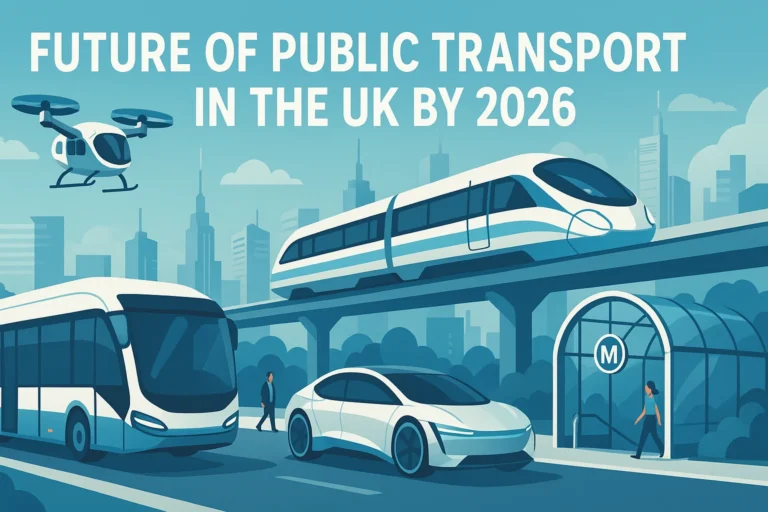
Public transport in the United Kingdom is on the cusp of a major transformation. With billions of pounds of government investment, smart metro and rail-network upgrades, and a renewed focus on sustainable, reliable, and accessible travel 2026 is shaping up to be a milestone year.
This article explores what’s coming by 2026: which projects are underway, where improvements will materialize, how everyday commuting might change and why these developments matter if you live, work, or travel in the UK or just care about future-ready infrastructure.
Big Investments & Upgrades: What the Government Has Greenlit
50+ Road and Rail Upgrades Across the Country
- In July 2025, the government announced approval for more than 50 road and rail upgrades, aimed at not only easing congestion and shortening travel times, but supporting 39,000 new homes and 42,000 jobs under its “Plan for Change.”
- The upgrades include major road schemes, motorway/trunk improvements, as well as rail enhancements targeting both intercity links and local/regional rail networks.
- For many regions, this could mean better connectivity to jobs, education, services and more reliable access for commuters, especially outside London, in smaller cities, towns and rural areas.
Regional Metro Systems Example: South Wales Metro
- One of the most exciting developments is the South Wales Metro, a modern integrated transport network combining heavy rail, light rail (tram-trains) and bus/rapid transit.
- As of late 2025, the first new fleet of 36 tram-trains is stabled in the newly opened depot at Taff’s Well.
- The plan is for the Metro to be fully operational by early 2026, with all lines electrified which promises faster, cleaner, more frequent, and more accessible travel for communities in and around Cardiff and the South Wales valleys.
- Once running, the Metro will mean better rail links not just for central Cardiff, but for formerly poorly connected areas giving people easier access to jobs, education, health services, and leisure without needing a car.
What’s Changing for Cities: Buses, Trams, and Urban Transport
Investment in Local & Urban Transport
- The 2025 funding boost isn’t just for intercity rail or big highways a large portion is directed at city‐region transport: buses, local trains, trams, and light-rail networks across the North, Midlands, South West and other regions.
- This means many towns and smaller cities will likely see more frequent bus or tram services, improved local connectivity, and better integration between different transport modes (bus ⇄ rail ⇄ light rail).
Emphasis on Sustainability, Decarbonisation & Accessibility
- For example, in urban areas, the trend is moving towards electrified transport, cleaner buses/trams/rail, and integrated networks that reduce dependence on cars. The South Wales Metro is a prime example, aiming to offer environmentally friendly, high-frequency transit.
- For many commuters, that could mean a shift: from car ownership or long commutes to a more affordable, reliable public transport lifestyle saving time, money, and contributing to lower carbon emissions.
Faster Rail, New Links & Upgraded Connectivity
Upgrades to Rail Network & New Stations
- As part of the 2025–onwards investment, rail upgrades and enhancements include expanding capacity, improving infrastructure, and connecting underserved areas.
- Some disused or historically closed railway lines may be revived (or at least feasibility studies / upgrades planned), improving connectivity for towns or suburbs that previously lacked good rail links.
Potential Benefits to Commuters & Regional Travel
- For residents in less-connected parts of the UK, these rail upgrades could dramatically reduce journey times, increase frequency, and make commuting more comfortable and reliable.
- It could also open up access to job markets, education and services for people living outside major cities increasing mobility and economic opportunity beyond urban centres.
Socio-Economic & Environmental Benefits
Upgraded public transport networks do more than just move people they can shape how and where people live, work, and travel. Here’s a look at broader benefits:
- Reduced traffic congestion & fewer cars: Better rail/tram/bus services could lower dependence on private vehicles, easing congestion and reducing air pollution, especially in urban areas.
- Affordable mobility: Public transport tends to be cheaper than owning and maintaining a car this can save households money, especially in high-cost areas.
- Improved access & equality: Regions that previously lacked good transport links may get better opportunities easier commute, access to education/healthcare, job markets and social mobility.
- Environmental gains: Electrified trains/trams, reduced car use, and integrated networks all support climate goals and cut carbon emissions.
What to Expect in 2026 What Public Transport Might Look Like
Here are concrete changes and improvements that many people across the UK could realistically see by 2026:
- In South Wales, a fully operational South Wales Metro, with frequent tram-train services connecting valleys and Cardiff, electrified lines, and integrated ticketing.
- In many English cities and towns, improved local bus / tram / light-rail services thanks to regional investments, making commuting and local travel easier.
- More towns connected to the national rail network (or re-connected), with improved stations, expanded rail capacity, and better scheduling meaning shorter, more reliable journeys.
- For commuters and travellers across the UK: cheaper, more efficient public transport, less reliance on cars, and better connectivity between regions, cities, and suburbs.
- A lean towards greener transport: more electric trains/trams, reduced environmental footprint, improved air quality, and alignment with UK’s decarbonization goals.
Challenges & What Needs Close Monitoring
No large-scale public transport overhaul comes without challenges. Here are some factors to watch:
- Implementation delays big projects (rail upgrades, metro networks, new lines) can face delays, budget changes or political shifts. What’s promised may not always deliver on time.
- Funding & maintenance while 2025’s funding boost is significant, ongoing maintenance, expansion, and upgrades will require long-term commitment and oversight.
- Integration between different systems to deliver a smooth user experience, buses, trams, trains and local transport must be well-integrated (schedules, ticketing, accessibility), which can be complicated across regions.
- Accessibility & equity success will depend on ensuring rural areas and smaller towns aren’t left behind, and transport upgrades benefit all residents, not only those in or near major cities.
- Behavioural change people accustomed to cars may take time to trust and adopt public transport, especially outside metro areas.
Why This Matters For Travellers, Residents, and the UK as a Whole
- Improved quality of life: Easier commuting, less time on the road, less stress, more access to services and opportunities.
- Economic growth & opportunity: Better connectivity can unlock jobs, education, and social mobility for under-served regions.
- Sustainability & environment: A shift from cars to public transport supports decarbonisation and improves urban air quality.
- Social inclusion: Good public transport links reduce the disadvantage of living outside major cities enabling equal access to benefits of urban life.
- Future-proof infrastructure: As the UK grows and changes, having a modern, reliable, integrated public transport system will be key to national development, housing, and urban planning.
What to Watch: Projects & Milestones in 2025–2026
Here are a few of the landmark projects and developments good to keep an eye on if you’re interested in UK’s transport future:
- Completion and full operation of the South Wales Metro by early 2026.
- Implementation of the 50+ road and rail upgrades across England improved roads, new/renovated railways, better connectivity nationwide.
- Enhanced local transport (buses, light rail, regional rail) in city regions thanks to increased regional transport investments.
- Progress on rail services expansion and station upgrades potentially giving more people access to rail transport than before, especially in underserved regions.
Conclusion
By 2026, public transport in the UK could look spectacularly different from today. Thanks to massive investments, rail-network upgrades, new metro systems, and a renewed focus on sustainable, accessible transit the country is gearing up for a seismic shift in how people travel.
For residents, commuters, students, workers and for UK society at large this could mean cheaper, faster, greener, more equitable transport options. If the plans deliver as promised, 2026 may mark the beginning of a new era of mobility in the UK.