
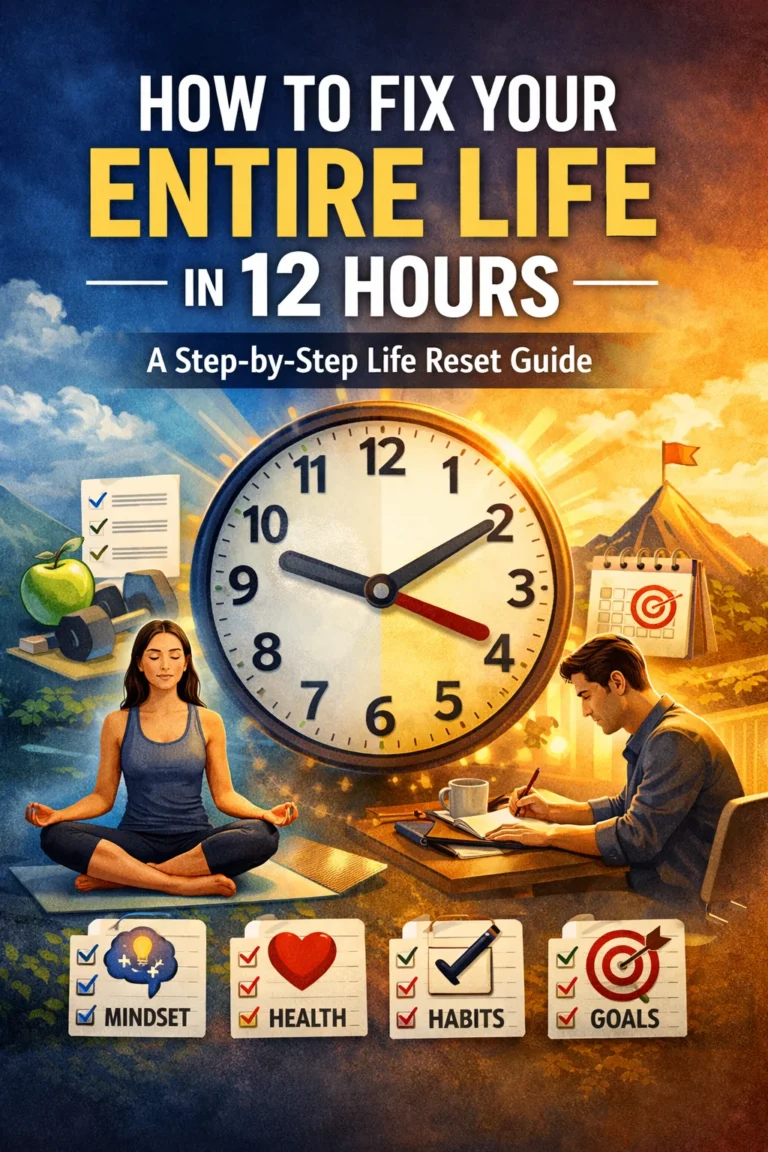
Have you ever wished for a reset button a strategic plan that helps you turn chaos into clarity, confusion into purpose, and overwhelm into momentum? If you’re here, you’re searching for How To Fix Your Entire Life in 12 hours. This isn’t about unrealistic transformations or overnight miracles. This is about a single-day overhaul framework, rooted in psychology, time science, and health research, that gives you clarity, energy, and actionable direction.
In this evidence-based guide, you will learn how to allocate 12 focused hours to address:
- Your mental clarity
- Your emotional wellbeing
- Your physical health
- Your habits and productivity systems
- Your goals and life purpose
By the end, you’ll walk away with a step-by-step checklist, tools grounded in research from the American Psychological Association and Harvard Health to WHO recommendations, and the confidence to make real progress in one day.
What Does “Fix Your Entire Life” Really Mean?
Definition: Fixing your life doesn’t mean changing everything all at once or achieving perfection instantly. It means establishing clarity, alignment, and systems you can consistently build on. Think of it as a restart event a day designed to help you:
- Understand your current state and stressors
- Eliminate what isn’t serving you
- Set clear priorities and actions you can take today
Fixing your life in 12 hours is about resetting your internal compass not rewriting your history.
For readers who prefers a more aggressive 24-hour overhaul, I also wrote a full walkthrough on How to Fix Your Entire Life in One Day (2026 Edition).
The Science of Life Resets: Why 12 Hours Can Make a Difference
How to Fix Your Entire Life in 12 Hours
Why Focused Time Works
Psychologists emphasize focused, intentional time blocks for cognitive reframing and action planning. Research shows even short, focused periods of intentional reflection and planning can significantly improve wellbeing and reduce anxiety (APA, 2019).
The 12-Hour Window is Practical
Twelve hours isn’t arbitrary. It’s long enough to:
- Conduct deep reflection
- Engage in health-boosting activities
- Create sustainable plans
- Build momentum
But short enough to avoid overwhelm.
Behavior Change Framework
According to research on habit formation (e.g., Charles Duhigg, The Power of Habit, 2012), transformation is a cycle of:
- Cue
- Routine
- Reward
This reset plan acts as a powerful cue paired with structured routines and rewards.
Life Overhaul Steps: A 12-Hour Roadmap
Pro Tip: Use a notebook or digital document to track your insights each hour.
Hour 1–2: Mental Clarity & Mindset Reset
Objective: Clear mental clutter and focus on what truly matters.
Step 1: Brain Dump (30 minutes)
- List everything weighing on you: tasks, worries, decisions, unresolved issues.
- Research confirms that externalizing thoughts reduces cognitive load and anxiety (Mayo Clinic).
Example prompts:
- What’s stressing me most?
- What decisions have I avoided?
- What tasks keep reappearing in my mind?
Step 2: Prioritize with the Eisenhower Matrix
Classify items into:
- Urgent & Important
- Important, Not Urgent
- Urgent, Not Important
- Neither
Research from time-management studies shows this improves decision-making clarity (Covey, 7 Habits, 1989).
Hour 3–4: Emotional Recalibration
Objective: Acknowledge and process emotions rather than suppress them.
Step 1: Guided Emotional Check-In (20 minutes)
Ask:
- What am I feeling?
- Why might I feel this way?
This builds emotional awareness, a key factor in resilience according to the American Psychological Association.
Step 2: Practice Mindfulness or Grounding (40 minutes)
Choose one:
- 20 minutes of mindfulness meditation
- Grounding exercises (deep breathing, progressive muscle relaxation)
Evidence shows mindfulness reduces stress and enhances cognitive control (NIH).
Example Grounding Script (5–7–8 Breathing):
- Inhale for 5 seconds
- Hold for 7
- Exhale for 8
Repeat 5 times
Hour 5–6: Physical Health Optimization
Objective: Support your body because your brain and habits depend on it.
Step 1: Hydration Reset
Dehydration affects cognition and mood. Aim for 500–750 mL of water to kickstart your body.
Step 2: Nutrient-Dense Meal
Build a balanced plate:
- Protein (30% of plate)
- Healthy carbs (30%)
- Vegetables & fiber (40%)
Harvard Health reports balanced meals improve mood and energy.
Step 3: Move Your Body (30 minutes)
Pick one:
- Brisk walk
- Yoga session
- Bodyweight exercises
Physical activity boosts endorphins and clarity.
Hour 7–8: Productivity & Habit Evaluation
Objective: Identify what helps or hinders you and redesign your systems.
Step 1: Audit Your Habits
List habits you want to:
- Stop
- Start
- Continue
Use the Tiny Habits Framework (BJ Fogg): Make it easy, obvious, and satisfying.
Step 2: Design Your Ideal Day
Write your day from:
- Wake time
- Morning routine
- Work/focus blocks
- Breaks
- Evening routine
Schedule:
- 90-minute deep work blocks (research shows this enhances productivity)
- Breaks every 50–60 minutes
Hour 9–10: Purpose, Goals & Planning
Objective: Clarify what you’re working toward and plan realistic actions.
Step 1: Define Your North Star
Ask:
- What matters most?
- What legacy or impact do I want?
Clarifying values increases motivation and reduces burnout (APA).
Step 2: Set SMART Goals
Your goals should be:
- Specific
- Measurable
- Achievable
- Relevant
- Time-bound
Example:
Complete a professional certification in 6 months with 5 weekly study sessions of 60 minutes.
Step 3: Backwards Plan
Start with your end result and work backward to:
- Weekly milestones
- Daily actions
- Habit triggers
Hour 11–12: Integration, Commitment & Next Steps
Objective: Anchor your reset with agreement and accountability.
Step 1: Summarize Insights
Create a one-page plan with:
- Top 3 priorities
- Daily habits
- Weekly milestones
Step 2: Accountability
Choose one:
- Share goals with a friend
- Join a group
- Set digital reminders
Research shows social accountability increases follow-through.
Step 3: Reward Yourself
Choose a meaningful, healthy reward (e.g., favorite meal, free time).
Rewards strengthen habit formation (behavior science).
Tools, Checklists & Worksheets
Life Reset Checklist
- Brain dump complete
- Priorities set with matrix
- Emotional check-in done
- Hydration + balanced meal
- Physical activity completed
- Habit audit conducted
- Ideal day planned
- SMART goals listed
- One-page plan finalized
- Accountability confirmed
Templates You Can Use
- Habit tracker
- Weekly planner
- Emotional check-in sheet
(Downloadable versions recommended for implementation)
FAQ
What does “fix your entire life in 12 hours” mean?
It means using a structured, intentional day to reset your clarity, wellbeing, habits, and goals not instant perfection but meaningful momentum.
Can a single day truly change my life?
Yes. Focused reflection, planning, and action backed by proven psychological and productivity frameworks can trigger meaningful progress (APA, NIH).
What’s the first step to begin?
Start with a brain dump to clear your mind. It improves clarity and reduces mental overload.
References
- American Psychological Association. Stress and Decision-Making.
- Harvard Health Publishing. Healthy Eating Plate vs USDA MyPlate.
- National Institutes of Health (NIH). Mindfulness and Stress Reduction Research.
- Covey, Stephen R. The 7 Habits of Highly Effective People.
- Duhigg, Charles. The Power of Habit.
Conclusion
You now have a complete, evidence-based playbook for how to fix your entire life in 12 hours. This isn’t a trick it’s a strategic reset that aligns your mind, body, habits, and goals. The transformation comes not from speed but from clarity, intention, and scientifically grounded steps you can take today and build on tomorrow.
When you’re ready, save this plan, revisit it weekly, and let your reset day become a powerful baseline for lifelong growth.