
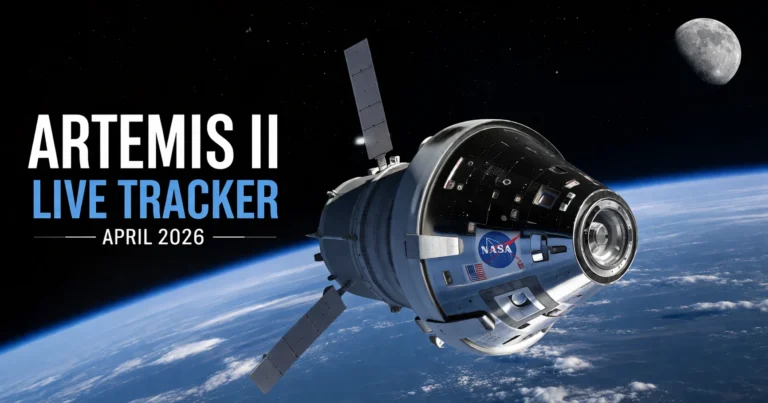
As of April 9–10, 2026, NASA’s Artemis II mission is on its final return leg to Earth, following a historic crewed journey around the Moon.
After launching in early April, the spacecraft successfully completed its lunar flyby and is now heading back toward Earth for reentry and splashdown, expected within hours.
Artemis II Current Location (Live Status)
- Mission phase: Return trajectory to Earth
- Position: Between the Moon and Earth (cislunar space)
- Speed: ~25,000 mph during reentry phase
- Status: Preparing for atmospheric reentry
- Expected splashdown: April 10, 2026 (Pacific Ocean)
Artemis II is following a free-return trajectory, meaning it loops around the Moon and naturally returns to Earth without needing major propulsion burns.
What Happened During the Mission?
Artemis II is NASA’s first crewed Moon mission in over 50 years, since Apollo.
Key milestones:
- Launch: April 1, 2026
- Left Earth orbit: April 2 (translunar injection burn)
- Moon flyby: Around April 6
- Record broken: Farthest distance humans have ever traveled (~252,000 miles)
- Return journey: Now underway
- Splashdown: Expected April 10
How to Track Artemis II Live
NASA provides real-time tracking tools so you can follow the spacecraft:
- Official Artemis Real-Time Orbit Website (AROW)
- Downloadable trajectory data (ephemeris)
- Telescope tracking for advanced users
These tools allow you to see:
- Exact spacecraft coordinates
- Distance from Earth and Moon
- Velocity and trajectory
Live Update: Artemis II is currently returning to Earth after its lunar flyby in April 2026.
This tracker updates automatically to reflect the current position and mission phase of Artemis II based on official NASA updates.
- 🚀 Mission: Artemis II
- 📍 Current Location: Updating…
- 🧭 Phase: Updating…
- 🌕 Distance from Moon: Updating…
- 🌍 Distance from Earth: Updating…
- ⚡ Speed: Updating…
- 🔄 Status: Updating…
Last updated: —
View Official NASA TrackerWhat Happens Next? (Reentry Phase Explained)
The most dangerous part of the mission is happening now:
- The Orion capsule will hit Earth’s atmosphere at ~25,000 mph
- Temperatures reach ~5,000°F (2,760°C)
- Heat shield protects astronauts during descent
If successful, Artemis II will:
- Safely splash down in the Pacific Ocean
- Complete a 10-day deep space mission
- Prove NASA can send humans beyond low Earth orbit again
Artemis II Crew
The four astronauts onboard are:
- Reid Wiseman (Commander)
- Victor Glover (Pilot)
- Christina Koch (Mission Specialist)
- Jeremy Hansen (Mission Specialist)
This mission includes:
- The first woman to travel to the Moon
- The first Black astronaut on a lunar mission
- The first non-American to orbit the Moon
Why Artemis II Matters
Artemis II is not just a flyby it’s a critical test mission.
It validates:
- Orion spacecraft systems
- Deep space navigation
- Human survival beyond Earth orbit
It also sets the stage for:
- Artemis III / IV Moon landing missions (late 2020s)
Quick Summary (April 2026 Update)
| Category | Status |
| Mission phase | Returning to Earth |
| Current location | Between Moon & Earth |
| Distance traveled | ~685,000 miles total |
| Next event | Atmospheric reentry |
| Splashdown | April 10, 2026 |
FAQs
Is Artemis II currently near the Moon?
No it has already completed its lunar flyby and is now heading back to Earth.
Can I watch Artemis II live?
Yes. NASA is streaming the reentry and splashdown live globally.
Will Artemis II land on the Moon?
No it’s a flyby mission, not a landing mission.
Final Thoughts
Right now, Artemis II is in its final and most intense phase the return home.
If reentry and splashdown go as planned, this mission will mark:
- Humanity’s successful return to deep space
- A major step toward permanent lunar exploration