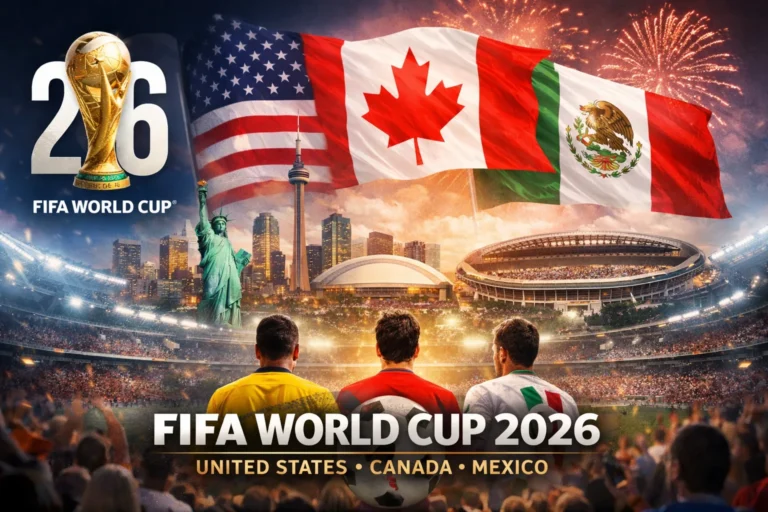
The definitive guide to the FIFA World Cup 2026. Explore host countries, cities, stadiums, expanded 48-team format, qualification, schedule, tickets, technology, and global impact.
Why the FIFA World Cup 2026 Is Historic
The FIFA World Cup 2026 stands as one of the most significant milestones in the history of global football. It is the first World Cup to be hosted by three nations simultaneously, the first to feature an expanded 48-team tournament, and the first edition designed explicitly for a continent-scale fan experience across North America.
More than just another tournament, FIFA World Cup 2026 represents a structural evolution of the sport. From expanded participation and unprecedented geographic reach to new technologies and sustainability standards, this edition reshapes how the World Cup is organized, experienced, and consumed worldwide.
For fans, students, travelers, and researchers alike, understanding FIFA World Cup 2026 means understanding the future direction of international football.
Overview of the FIFA World Cup 2026
The FIFA World Cup 2026 will be the 23rd edition of FIFA’s flagship international football competition.
Key overview facts:
- Tournament year: 2026
- Host countries: United States, Canada, Mexico
- Number of teams: 48 (expanded from 32)
- Total matches: 104
- Expected duration: Approximately 39 days
- Governing body: FIFA
This tournament introduces a new competitive structure while maintaining the World Cup’s core identity: a month-long celebration of international football featuring the world’s best national teams.
Host Countries: United States, Canada, and Mexico
FIFA World Cup 2026 will be jointly hosted by three countries, each contributing unique football heritage, infrastructure, and cultural depth.
United States
The United States will host the majority of matches, including all games from the quarterfinal stage onward.
Key characteristics:
- Largest number of host cities and stadiums
- Extensive experience hosting global sporting events
- Advanced transportation, accommodation, and broadcasting infrastructure
The United States previously hosted the World Cup in 1994, which remains the highest-attended edition in tournament history.
Canada
The Canada hosts World Cup matches for the first time in men’s tournament history.
Key characteristics:
- Rapidly growing football culture
- Modern stadium facilities
- Strategic representation of the northern region of the confederation
Canada’s inclusion reflects FIFA’s goal of expanding the tournament’s geographic and cultural footprint.
Mexico
The Mexico becomes the first nation to host men’s World Cup matches in three different editions (1970, 1986, 2026).
Key characteristics:
- Deep football traditions
- Iconic stadiums
- Passionate fan culture
Mexico’s role provides historical continuity while supporting regional balance.
Host Cities and Stadiums (Venues Overview)
FIFA World Cup 2026 will be played across 16 host cities, featuring some of the largest and most technologically advanced stadiums ever used in the tournament.
United States Host Cities and Stadiums
- New York/New Jersey – MetLife Stadium
- Los Angeles – SoFi Stadium
- Dallas – AT&T Stadium
- Miami – Hard Rock Stadium
- Atlanta – Mercedes-Benz Stadium
- Seattle – Lumen Field
- San Francisco Bay Area – Levi’s Stadium
- Boston – Gillette Stadium
- Philadelphia – Lincoln Financial Field
- Kansas City – Arrowhead Stadium
- Houston – NRG Stadium
Canada Host Cities and Stadiums
- Toronto – BMO Field
- Vancouver – BC Place
Mexico Host Cities and Stadiums
- Mexico City – Estadio Azteca
- Guadalajara – Estadio Akron
- Monterrey – Estadio BBVA
Each venue meets FIFA’s requirements for pitch quality, capacity, media infrastructure, and security.
Tournament Format and the Expansion to 48 Teams
One of the defining features of FIFA World Cup 2026 is the expansion from 32 to 48 teams.
New Tournament Structure
- 12 groups of four teams
- Top two teams from each group qualify
- Eight best third-placed teams advance
- Round of 32 introduced for the first time
Total matches: 104
Final stages: Round of 32 → Round of 16 → Quarterfinals → Semifinals → Final
This format increases global representation while preserving competitive balance.
Qualification Process by Confederation
FIFA World Cup 2026 qualification allocates slots based on confederation size and competitiveness.
Qualification Slots Breakdown
- AFC (Asia): 8 direct + 1 playoff
- CAF (Africa): 9 direct + 1 playoff
- CONCACAF: 6 direct (including hosts) + 2 playoff
- CONMEBOL: 6 direct + 1 playoff
- OFC (Oceania): 1 direct + 1 playoff
- UEFA (Europe): 16 direct
This expanded allocation allows more nations to participate than ever before.
Match Schedule Overview and Timeline
While exact fixtures are released closer to kickoff, the tournament follows a structured timeline:
- Opening match: Early June 2026
- Group stage: First three weeks
- Knockout rounds: Late June to mid-July
- Final match: Mid-July 2026
Matches will be spread across multiple time zones to optimize global broadcast accessibility.
With the World Cup being one of the world’s most watched and attended events, securing your official ticket… Read more>>
Teams to Watch at FIFA World Cup 2026
Without predictions or rankings, several national teams attract attention due to history, development, or recent performance cycles.
Traditional Global Powers
- Brazil
- Germany
- Argentina
- France
Host Nation Representation
- United States
- Canada
- Mexico
Emerging and Expanding Participants
The expanded format ensures first-time or rare appearances from multiple regions, increasing competitive diversity.
Cultural, Economic, and Global Impact
FIFA World Cup 2026 is expected to be one of the most economically impactful sporting events ever staged.
Cultural Impact
- Celebration of multicultural fan identities
- Cross-border fan travel and exchange
- Expansion of football culture in North America
Economic Impact
- Infrastructure investment
- Tourism growth across 16 cities
- Job creation in hospitality, transport, and media
The tournament’s tri-national structure also sets a precedent for future mega-events.
Technology, Sustainability, and Innovation
FIFA World Cup 2026 integrates advanced technologies and sustainability goals.
Key Innovations
- Semi-automated offside technology
- Enhanced VAR systems
- Smart stadium operations
Sustainability Measures
- Reduced new stadium construction
- Emphasis on existing venues
- Climate-conscious logistics planning
The event aligns with FIFA’s long-term environmental and technological strategies.
Fan Experience, Travel, and Tickets
Fan Experience
- Fan zones in all host cities
- Cultural festivals and exhibitions
- Multilingual services
Travel Considerations
- Cross-border travel requirements
- Multiple currencies and visa policies
- Integrated transportation planning
Tickets (Informational)
Tickets are distributed through official FIFA platforms in multiple sales phases, with categories designed for global accessibility.
Broadcasting and Global Viewership
FIFA World Cup 2026 is projected to reach billions of viewers worldwide.
Broadcasting Highlights
- Ultra-high-definition coverage
- Digital streaming platforms
- Expanded multilingual commentary
Media rights agreements ensure accessibility across traditional television and digital platforms.
Key Differences From Previous World Cups
- First 48-team tournament
- First three-country host model
- Largest number of matches
- Most geographically dispersed venues
These changes mark a structural shift in World Cup organization.
Frequently Asked Questions
What is FIFA World Cup 2026?
The FIFA World Cup 2026 is the 23rd edition of the men’s FIFA World Cup, hosted by the United States, Canada, and Mexico.
How many teams will compete?
A total of 48 national teams will participate.
Which countries are hosting?
The United States, Canada, and Mexico.
How long will the tournament last?
Approximately five and a half weeks, from June to July 2026.
Is this the first expanded World Cup?
Yes, it is the first World Cup to feature 48 teams.
Conclusion
The FIFA World Cup 2026 represents a defining moment in the evolution of international football. With its expanded format, unprecedented tri-national hosting model, and emphasis on inclusivity, technology, and sustainability, it sets new standards for global sporting events.
Beyond matches and results, FIFA World Cup 2026 is a cultural and organizational landmark reshaping how the world experiences football on its biggest stage.